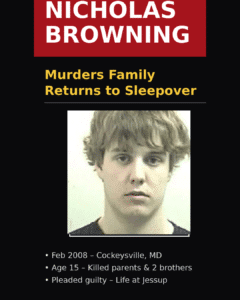

Nicholas Browning was fifteen years old living in Maryland when he would murder his parents and two siblings
According to court documents Nicholas Browning would stay at a friends home and then sneak out in the middle of the night. Nicholas would return to his own home and murder his parents, John and Tamara Browning, and his two younger brothers, Gregory, 13, and Benjamin, 11, as they slept in their beds
Nicholas Browning would return to his friends home and stay there for a couple of days before telling the friend what he had done
Nicholas Browning would be arrested, plead guilty to four counts of murder and would be sentenced to life in prison with no chance of parole for twenty years
Where Is Nicholas Browning Today
Nicholas Browning is currently incarcerated at the Jessup Correctional Institution
Nicholas Browning Current Information
| Full Name | DOC # | SID | Gender | DOB | Facility | Facility |
|---|---|---|---|---|---|---|
| NICHOLAS BROWNING | 355015 | 3225740 | Male | 02/1992 | JCI | Jessup Correctional Institution |
Nicholas Browning Case
The young man who murdered his parents and two younger brothers at their Cockeysville home when he was 15 appeared in a Baltimore County courtroom Friday, asking for a reduced sentence.
Derek Valcourt was in the courtroom and has more on the plea for mercy and the judge’s response.
Attorneys for the now 21-year-old were trying to argue that by slightly altering his sentence and allowing him to take part in a youth offender program, Nicholas Browning might have a shot of getting paroled someday.
But the judge wasn’t having it.
Browning is now serving two consecutive life sentences after confessing to the February 2008 murders of his parents, John and Tamara, and his brothers, 14-year-old Gregory and 11-year-old Benjamin, as the four slept in their Cockeysville beds.
Police: “Do you remember where you shot your dad on his body?”
Browning: “In the head.”
Police: “How about your mom?”
Browning: “In the head.”
Police: “Your brothers too then?”
Browning: “The head.”
Police: “Why did you do that?”
Browning: “I figured it would be quicker.”
In court Friday, Browning’s attorneys asked a judge to consider a reduced sentence, which would allow him to qualify for special programs at the Patuxent Institution and in turn perhaps one day even be eligible for parole.
That’s an argument prosecutors rebutted.
“This crime was so heinous that Nicholas Browning should never get out of jail,” said Robin Coffin, prosecutor.
Before the judge made his decision, Browning spoke briefly in court, saying “words can’t adequately describe what I did.”
He also said he would give his own life if he could just take it all back.
“For a 15-year-old boy to do something like that, there is obviously something wrong in the family,” said Michael Gaffney, Browning’s pen pal.
Gaffney became Browning’s pen pal and now visits him monthly in prison.
He was one of Browning’s few supporters inside the courtroom.
“I was really hoping that the court would consider all of the facts surrounding the case,” Gaffney said.
But the judge denied Browning’s request, sending him back to prison for life.
This was Browning’s last shot at getting a reduced sentence.
Prosecutors say Browning killed his parents because he didn’t want anyone telling him what to do and that he killed his brothers so he wouldn’t have to share an inheritance.
No Sentence Reduction For Cockeysville Man Who Murdered His Entire Family At Age 15 – CBS Baltimore
Nicholas Browning News
An honor student and former Boy Scout pleaded guilty Monday to fatally shooting his sleeping family, then going back to a friend’s house to play video games.
Nicholas Browning, 16, of Cockeysville pleaded guilty to four counts of first-degree murder in the February slayings of John W. Browning, 45; Tamara, 44; Gregory, 14, and Benjamin, 11. In exchange for his plea, he will serve at least two decades in prison but will not serve life without parole.
The killings stunned the upscale Baltimore suburb where the family lived. The family was active in a local church and widely respected in the community, and nearly 1,300 people attended a funeral service for them.
Though authorities painted the most complete picture yet in court Monday of how the chilling crime happened, Browning’s motive remains a mystery. The teen cried as prosecutors described the killings, accepting a tissue from a sheriff’s deputy, but said little else.
Used gun owned by father
According to a statement of the crime read in court, Browning asked his brother, Gregory, to leave the basement door unlocked, then walked home from a friend’s house after midnight on Saturday, Feb. 2. In the basement, he put on a pair of gloves and picked up a handgun belonging to his father and a spare magazine.
His father was asleep on a sofa on the first floor. Nicholas shot him in the head, then waited for the rest of his family to come downstairs.
When they failed to stir, he went to his mother’s bedroom and shot her twice as she slept, prosecutors said. Then he moved on to his brothers’ bedroom. He shot Gregory once in the head. At that point, Benjamin began to stir. Benjamin lifted his hand to shield himself, and Browning shot his youngest brother twice in the face. One bullet grazed the boy’s left index finger.
After the slayings, Browning returned to his friend’s house, played video games and pretended nothing had happened. The following day, Browning and his friends went to a shopping mall, and he placed several calls to his family, leaving them messages to say he loved them and would see them soon. A friend’s father drove him home, and Browning emerged from the house to say something was wrong with his father. The friend’s father saw John Browning’s body and called police.
Browning later confessed to the slayings and told police where they could find the murder weapon.
Psychiatric testimony
Other than noting that the teen had been arguing with his father, police and prosecutors have not detailed a motive. Dr. Neil H. Blumberg, a forensic psychiatrist for the defense, testified at an earlier hearing that Browning was physically and verbally abused by his parents and thought he could do nothing to please them. However, state psychiatrists have said they do not believe he was mentally ill.
Blumberg said Nicholas Browning had disruptions in consciousness, memory and perception on the night of the killings and that Browning indicated he was in “a trancelike state.” The psychiatrist also testified that relatives and friends told him they had seen Nicholas’ parents abuse him. He said the family had a history of alcoholism and that John, Tamara and Nicholas abused alcohol.
Browning was a week shy of his 16th birthday at the time of the slayings, too young under state law to face the death penalty. When he is sentenced Dec. 2, he faces two consecutive life terms. Under state parole guidelines, he could become eligible for parole in 23 years if he is a model inmate — though state officials say murderers are rarely granted parole at their first hearing.
Defense lawyers asked that Nicholas Browning serve his sentence at Patuxent Institution in Jessup, a facility that provides psychiatric treatment.
Browning’s grandmother, Margaret Browning, was in the courtroom Monday morning as attorneys hammered out the deal but was not present when her grandson entered the plea. Other relatives did not speak to reporters as they left court. Attorneys also did not comment, and the judge kept a gag order in the case intact until sentencing
Md. teen pleads guilty to murdering family
Nicholas Browning Video
Watch Nicholas Browning Video – Teens Who Kill
Watch Nicholas Browning Murders Family – YouTube
Nicholas Browning: The 15-Year-Old Who Murdered His Family in Cockeysville, Maryland (2008)
On February 1, 2008, in the affluent suburb of Cockeysville, Baltimore County, 15-year-old Nicholas Waggoner Browning did the unthinkable. The Dulaney High School sophomore, Boy Scout, and varsity athlete left a friend’s sleepover in the middle of the night, walked two miles home, and used his father’s 9mm handgun to shoot his entire family as they slept.
By sunrise, John and Tamara Browning and their two youngest sons, Gregory and Benjamin, were dead. Nicholas went back to his friend’s house, played video games, and spent the next two days planning a party at the murder house.
It remains one of Maryland’s most infamous teen familicides — not because it was random, but because it was so coldly calculated.
Who Was Nicholas Browning?
Nicholas Waggoner Browning was born February 9, 1992, in Maryland. To outsiders, he was the definition of a privileged all-American kid.
His father, John W. Browning, 45, was a successful attorney. His mother, Tamara, 44, was a homemaker. Nicholas was an honors student at Dulaney High School in Timonium, played varsity golf and lacrosse, and was close to becoming an Eagle Scout.
That image shattered on February 3, 2008, when he confessed to the quadruple homicide of his family.
The Browning Family: Life at 10905 Powers Ave
The Brownings lived in a five-bedroom colonial at 10905 Powers Ave in Cockeysville — later described by realtors as “stunningly renovated” but infamous locally. Neighbors called them an “all-American family.”
Inside, classmates said, Nicholas was different. He was known as a spoiled kid who thought he ran the world. He joked about killing his parents several times before their deaths, several students said.
One Dulaney classmate, John Lockwood, told reporters: “He often complained about his father, and I specifically remember him saying he would kill his family one day in a joking manner.”
Other students on his bus said he recently began talking about killing his parents, but none took him seriously. He talked about how rich his father was, how he wanted some of that money. He didn’t like his father because he used to always yell at him.
Lockwood also claimed Nicholas had “another side” away from school where he would beat up his younger brothers really badly, steal from his dad’s liquor cabinet, and steal their car without a permit or license.
The Warning Signs Prosecutors Later Used
The motive in the Browning case has always been disputed.
The defense and Nicholas himself alleged abuse by his strict father. Prosecutors argued something far simpler: he murdered his parents “because he didn’t want anyone telling him what to do” and his brothers so that he would not be required to share his inheritance.
Deputy State’s Attorney Robin Coffin later summarized it bluntly: “At the time of the murder, when he was speaking with detectives, the only thing he said about his parents was that they were harsh and strict.”
Timeline: The Night of February 1, 2008
This is the established timeline from court documents and his confession:
Friday evening, Feb 1: Nicholas was spending the night at a friend’s house. John Browning had wanted his eldest son to accompany the family to western Maryland on Saturday, but Nicholas wanted to stay home and party.
Around 1-2 AM, Feb 2: Nicholas abruptly left his friend’s house and walked more than two miles to his parents’ home. He let himself in after other family members were in bed.
The murders: Using a gun belonging to his father, he shot each of them. He shot his father, John, his mother, Tamara, his 13-year-old brother Gregory, and his 11-year-old brother Benjamin as they slept in their beds. The weapon was a 9mm handgun.
He later told police he tossed his father’s gun into nearby bushes.
After the killings: He walked back to his friend’s house, returning five hours later. He spent Friday night and all day Saturday with friends, playing video games and acting normal.
Nicholas Browning would fatally shoot his parents and his two younger brothers then would spend the next two nights at a friends house before telling anyone what had happened.
The Staging: A Party Over Dead Bodies
What makes the Browning case uniquely chilling is the staging.
On Saturday, February 2, Nicholas began inviting friends to a party at his house on Saturday night, before returning home and faking surprise at finding their dead bodies. As police worked the crime scene that Saturday night, officers were repeatedly interrupted as students, unaware of the horror inside the home, kept arriving expecting a party.
He was dropped off at his house by his friends the next day, February 2, where he called the police at around 5 p.m. to inform them of the bodies. He initially claimed a botched robbery led to the murders.
The Interrogation That Broke Him
Baltimore County detectives immediately found inconsistencies. Nicholas claimed he had been at a friend’s all night, but phone records, footprints in snow, and his demeanor didn’t match.
After about six hours of interrogation, he admitted to the murders after police found inconsistencies in his story.
The interrogation video — now infamous on YouTube as “The Most Shocking Teenager Interrogation Ever” — shows a teenager who is detached, yawning, and at one point appears to fall asleep in the interview room. He showed no empathy in the killing of his family, prosecutors would later argue.
He confessed on Sunday, February 3, and was charged with four counts of first-degree murder. He was denied bail at a hearing on February 5.
The Victims
The Browning family murders were the quadruple homicide of a family in Maryland in 2008. The victims were:
- John W. Browning, 45 – father, attorney
- Tamara Browning, 44 – mother, homemaker
- Gregory Browning, 13 – brother
- Benjamin Browning, 11 – brother
All four were found shot in their beds at their Cockeysville home.
The Funeral and Family Forgiveness
In a twist that shocked the community, Nicholas marked his 16th birthday behind bars in the Baltimore County Detention Center Saturday, the same day about 1,300 people attended a funeral for his family at Trinity Assembly of God church in Lutherville.
In a statement released after the funeral, family members expressed support for Nicholas Browning.
“Our concern and love goes out to Nick,” they wrote. “Whatever else lies ahead, he is a member of our family and he will have our support.”
Guilty Plea and Sentencing
Although Nicholas alleged he had suffered abuse from his father, prosecutors argued the inheritance motive. Under a plea agreement reached with prosecutors, Browning pleaded guilty in January 2009 to four counts of first-degree murder and was sentenced to four life terms in prison with two life terms to be served consecutively.
He was sentenced to four life terms in prison, with the possibility of parole. Browning may become eligible for parole in 2031 after serving 23 years of his sentence with good behavior.
At sentencing, the judge called it an “unfathomable act.” Nicholas spoke only briefly: “Words can’t describe what I did.”
Where Is Nicholas Browning Now?
As of 2026, Nicholas Waggoner Browning is incarcerated at Western Correctional Institution in Cumberland, Maryland (he was previously listed at Jessup Correctional Institution).
He is now 34 years old. His earliest parole eligibility remains 2031, when he will be 39 and will have served 23 years.
In 2014, Browning, then 21, asked a Baltimore County judge to reduce his sentence. His attorneys argued that his multiple life sentences were preventing him from getting mental health treatment at the Patuxent Institution, which works with youth offenders. His attorney Joshua Treem argued that reducing several of the murder counts “doesn’t get him out any earlier” but would make him eligible for treatment.
Judge Thomas J. Bollinger Sr. denied the motion. Deputy State’s Attorney Robin Coffin said Browning’s sentence was appropriate because he showed no empathy in the killing of his family. “It was the state’s position at the time of sentencing and the state’s position today this crime was so heinous that Nicholas Browning should never get out of jail.”
Why This Case Still Haunts True Crime
The Nicholas Browning case is studied for three reasons:
- The mask of normalcy. He was an honors student close to becoming an Eagle Scout, not a troubled dropout. This challenges the “bad kid” stereotype.
- Premeditation without psychosis. He planned the walk, the gun, the alibi, the party cover story, and the disposal of the weapon. He then slept normally for two nights.
- The inheritance motive in juveniles. Unlike rage killings, prosecutors proved a cold financial motive — kill parents to get freedom, kill brothers to avoid sharing the estate.
The murders were the subject of a documentary on Killer Kids titled “Spoiled Rotten and Bad Dream”, cementing his nickname in true crime circles as the “spoiled rotter.”
The House That Won’t Forget
The five-bedroom home at 10905 Powers Ave is where Nicholas Browning, a Dulaney High School sophomore, killed his parents and two little brothers in February 2008. It was sold in 2010 to a new family despite its history.
In a bizarre twist, 15 years later in February 2023, the same house became the scene of another violent crime when David Linthicum shot a police officer in the basement — the exact same basement Browning had entered during the early hours of February 1, 2008 — touching off a three-day manhunt.
How old was Nicholas Browning when he killed his family?
15 years old. The murders happened on February 1, 2008, exactly one week before his 16th birthday on February 9.
What weapon did Nicholas Browning use?
A 9mm handgun belonging to his father, attorney John Browning. He shot each victim as they slept.
Did Nicholas Browning get parole?
Not yet. He was sentenced to four life terms with two consecutive. He may become eligible for parole in 2031 after serving 23 years with good behavior.
What was his motive?
Disputed. Nicholas claimed his father was abusive and strict. Prosecutors said he killed because he didn’t want anyone telling him what to do and wanted his inheritance without sharing it with his brothers.
Where is Nicholas Browning now?
Incarcerated at Western Correctional Institution in Maryland.
Did he show remorse?
In court he said “Words can’t describe what I did,” but detectives and prosecutors consistently noted his flat affect, lack of empathy during interrogation, and his ability to party with friends for two days while his family lay dead.
Final Thoughts: Privilege, Rage, and a Calculated Choice
The Browning family murders are not a story of a snap decision. They are a story of entitlement curdling into violence. Nicholas Browning had every advantage — private school, sports, scouts, a wealthy family — and he traded it all for a night of absolute control.
For true crime readers in Maryland and beyond, the case remains a warning: the most dangerous teen killers don’t always look troubled. Sometimes they look like the kid next door who just got grounded for bad grades, and who jokes about killing his parents until one night, he stops joking.